



Per Curiam Affirmed: When Appellate Losses Hurt Most


Reviewed by Michael P. Maddux, Esq. | Board Certified Criminal Trial Lawyer | Florida Super Lawyer for 16 Consecutive Years
What Does Per Curiam Affirmed Mean?
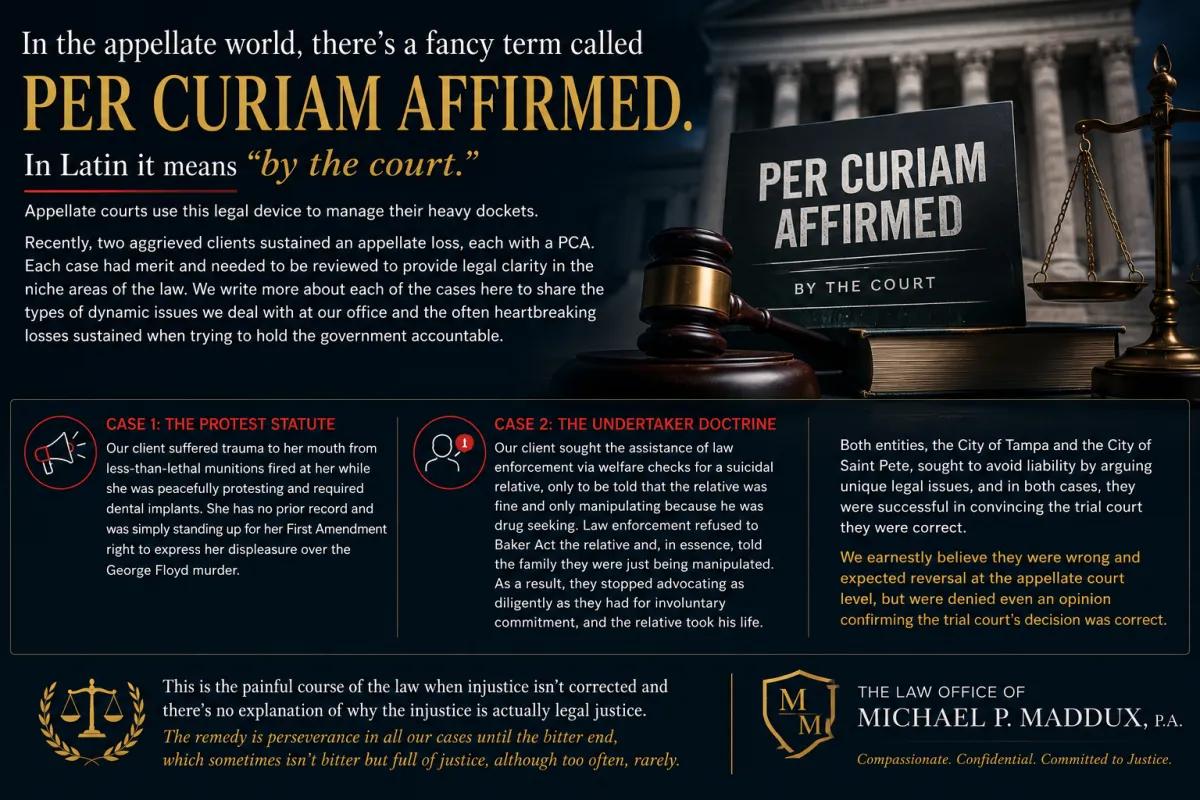
In the appellate world, there’s a fancy legal term called per curiam affirmed. In Latin, it essentially means the appellate court agrees with the lower court’s decision. It does this without issuing a written opinion explaining why. Appellate courts use this legal device to manage their heavy dockets. Recently, two aggrieved clients sustained an appellate loss, each with a per curiam affirmed. Each case had merit and the courts needed to review it to provide legal clarity in the niche areas of the law. We write more about each of the cases here to share the types of dynamic issues we deal with at our office. These cases often involve heartbreaking losses when we try to hold the government accountable.
Case One: The Protest Statute Ruling
One case involved the new protest statute. The other involved a unique tort law doctrine called the undertaker doctrine. In the first case, our client suffered trauma to her mouth from less-than-lethal munitions that police fired at her while she was peacefully protesting and required dental implants. She has no prior record and was simply standing up for her First Amendment right to express her displeasure over the George Floyd murder. The appellate court’s per curiam affirmed decision left this ruling unexplained.
Case Two: The Undertaker Doctrine and a Baker Act Failure
In the second case, our client sought the assistance of law enforcement via welfare checks for a suicidal relative. Officers told her the relative was fine and was only manipulating her because he was drug seeking. Law enforcement refused to Baker Act the relative and, in essence, accused the family of being manipulated. As a result, they stopped advocating as diligently as they had for involuntary commitment, and the relative took his life.
Both entities, the City of Tampa and the City of Saint Pete, sought to avoid liability by arguing unique legal issues. In both cases, they convinced the trial court they were correct. We earnestly believe they were wrong and expected reversal at the appellate court level, but were denied even an opinion confirming the trial court’s decision was correct, a per curiam affirmed ruling that offers no explanation. This is the painful course of the law when injustice isn’t corrected and there’s no explanation of why the injustice is actually legal justice. The remedy is perseverance in all our cases until the bitter end. Sometimes that end isn’t bitter but full of justice, though too often, it is.