



Florida’s Move Over Law Explained


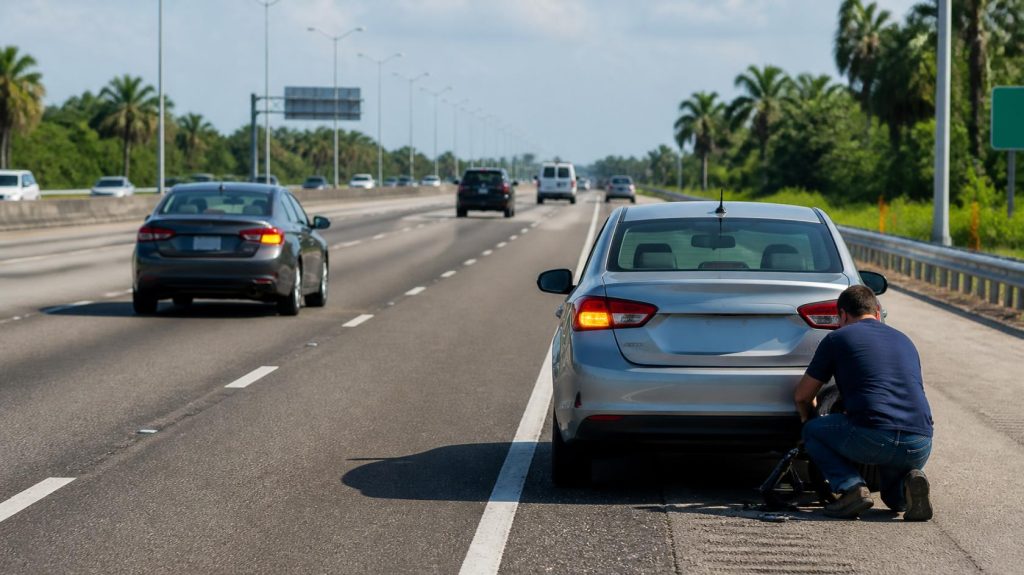
Michael was driving on I-275 when he passed a car pulled onto the shoulder, hazard lights blinking, no one in sight but the driver crouched by a flat tire. He stayed in his lane and kept going. He didn’t realize he’d broken Florida’s move over law.
What Florida’s Move Over Law Requires
Florida Statute § 316.126 requires drivers approaching a vehicle stopped on the roadside to act as soon as it’s safe. This includes an emergency vehicle displaying lights, a sanitation or utility vehicle performing a task, a wrecker with amber lights performing a recovery, a road or bridge maintenance vehicle, or a disabled motor vehicle displaying hazard lights or warning signals, or with people visibly present. Drivers must:
- Vacate the lane closest to that vehicle if driving on a road with two or more lanes in that direction, or
- If that can’t be done safely, slow to 20 mph below the posted limit, or 5 mph if the limit is 20 mph or less, on a two-lane road.
Penalties for Violating the Move Over Law
A violation is a noncriminal traffic infraction. The base civil penalty is $30 under § 318.18(2)(d), plus additional court costs and fees that attach to moving violations generally.
Section 316.126(6) classifies the offense as a moving violation, rather than nonmoving, for licensing purposes. Because of this, it also carries 3 points on the driver’s license under § 322.27(3)(d)8, the catch-all category for “all other moving violations,” since the statute doesn’t list Move Over violations as a separately scored offense.
The Lesson
Unfortunately, a few weeks later, Michael got the citation himself. The lesson stuck: move over if you can, slow down if you can’t. Florida’s move over law applies either way, and it comes with a fine and points attached.
Reviewed by Michael P. Maddux, Esq. | Board Certified Criminal Trial Lawyer | Florida Super Lawyer for 16 Consecutive Years